
Ever felt like you’re just reciting the Quran without truly knowing what the words mean?
You’re not alone—and the good news is, it doesn’t have to stay that way.
Learning the Quran word for word is one of the simplest ways to move from just reading to actually understanding what Allah is saying to us every day. You don’t need to be an Arabic scholar. You don’t need years of grammar study. You just need the right method and the right book.
In this guide, we’ll show you how studying the Noble Quran word for word can help you understand your Salah, daily recitation, and common duas—step by step. We’ll talk about easy word-to-word learning, transliteration options like Roman Urdu and English, and why Indo-Pak script Qurans are preferred by readers in India.
Whether you’re a busy student, a working professional, or a parent teaching your children at home, this approach is made for real life. Together, we’ll explore practical tools, trusted resources, and where to find authentic Qurans from Islamic books stores online in India.
What Does “Quran Word for Word” Mean?
Quran word for word simply means learning the meaning of each Arabic word as you read the Quran—line by line, word by word. Instead of reading a full sentence translation at the bottom, you see the meaning of every word right above or below the Arabic text. This helps your brain connect Arabic words with their meanings naturally.
Why Many Muslims Can Read but Don’t Understand Arabic
Most of us learned how to read the Quran as children. We focused on pronunciation, tajweed, and fluency. But understanding Arabic grammar or vocabulary was often skipped. So we recite beautifully—but don’t always know what we’re saying in Salah or daily tilawat.
Word-for-Word vs Tafsir vs Translation
Each method has its place:
- Word-for-word Quran: Helps you understand each word you recite
- Translation: Gives the overall meaning of verses
- Tafsir: Explains deeper context and lessons
Why Learning the Quran Word to Word Changes Your Salah
Learning the Quran word to word brings a powerful shift in your Salah. When you understand what you’re saying, your prayer no longer feels rushed or mechanical. It becomes personal. Alive. Meaningful.
Understanding Common Words Used in Daily Prayers
Many words in Salah repeat every single day. When you learn them once, they stay with you:
- Alhamdulillah – all praise
- Rabb – Lord, Sustainer
- Rahman / Raheem – Most Merciful
- Ihdina – guide us
- Sirat – path
Seeing these meanings while reading the Quran word for word helps them stick naturally.
How Meaning Improves Focus (Khushu)
When your mind understands the words, it stops wandering. You’re no longer thinking about “what comes next.” You’re thinking about Allah’s message. This understanding increases khushu—that deep focus and calm we all want in prayer.
Who Should Study the Quran Word for Word?
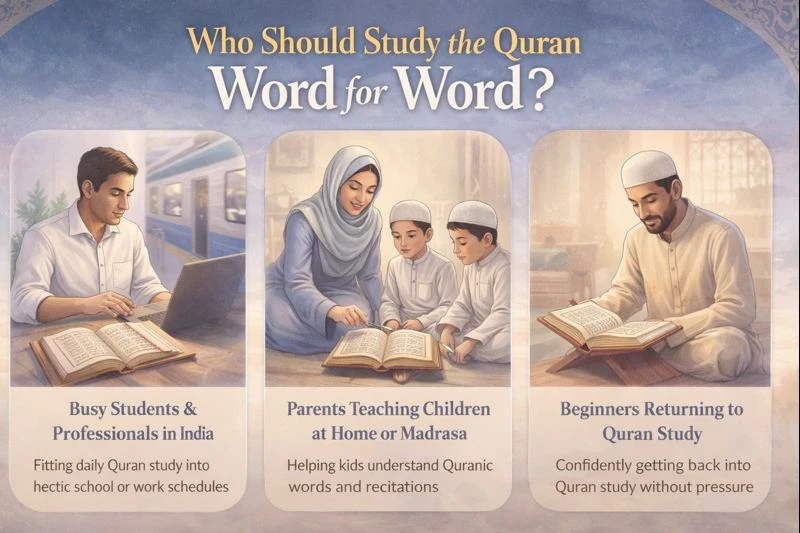
The Quran word for word method is not only for scholars or full-time students. It’s designed for everyday Muslims who want understanding without pressure. If you can read the Quran but struggle with meaning, this approach is for you.
Busy Students & Professionals in India
If your day is packed with studies, work, or travel, word-to-word learning fits easily into your routine. You don’t need long classes. Even 10–15 minutes a day can help you understand common Quranic words used in Salah and daily recitation.
Parents Teaching Children at Home or Madrasa
Many parents want their children to understand what they read, not just memorize. A Quran word-for-word format makes learning easier and more engaging, especially when combined with Urdu or English transliteration.
Beginners Returning to Quran Study
If you’re coming back to the Quran after a long break, this method feels welcoming—not overwhelming. It builds confidence step by step.
Indo-Pak Script: Why It Matters for Indian Readers
For many Muslims in India, the Indo-Pak script Quran feels more natural and comfortable to read. It’s the script most of us learned in childhood, whether at home or in the madrasa. When you combine this familiar layout with Quran word for word learning, understanding becomes much easier.
Difference Between Indo-Pak and Arabic Mushaf
The main difference is not the words—but the writing style and layout:
- Indo-Pak script: Rounded letters, clearer spacing
- Arabic (Uthmani) script: Compact style, common in Middle East prints
Indian readers often find Indo-Pak script easier on the eyes, especially for long recitation.
Why Indian Madrasas Prefer 13-Line or 15-Line Quran
Most madrasas in India use 13-line or 15-line Qurans because they help with:
- Better line-by-line memorization
- Clear word alignment for learning
- Easier tracking during Salah practice
Quran with English Transliteration – Is It Helpful?
A Quran with English transliteration shows Arabic words written in English letters. This helps readers pronounce the words correctly even if they can’t read Arabic script fluently. It’s often used alongside a Quran word for word layout for better understanding.
What Is English Transliteration Quran?
Instead of Arabic letters, you’ll see lines like Alhamdu lillahi Rabbil ‘aalameen. This doesn’t replace the Arabic Quran, but it supports correct reading while learning meanings.
Who Benefits Most from Roman Script Support?
English transliteration is helpful for:
- Beginners who are new to Arabic reading
- Teenagers and adults returning to Quran study
- Parents guiding children at home
Quran in Roman Urdu and Urdu Transliteration Explained
A Alfi Quran in Roman Urdu writes Arabic words using the Roman (English) alphabet, but with Urdu-style pronunciation. It’s especially popular in India and Pakistan, where many people understand Urdu but struggle with Arabic script.
Difference Between Urdu Translation and Transliteration
It’s easy to mix these up:
- Urdu translation: Explains the meaning of the verse in Urdu
- Urdu transliteration (Roman Urdu): Shows how to read the Arabic words
Transliteration helps with pronunciation. Translation helps with understanding. Word-for-word Qurans often combine both.
Is Roman Urdu Quran Suitable for Children?
Yes, as a support tool. It helps children read confidently while they slowly learn Arabic letters.
Step-by-Step: How to Start Learning the Noble Quran Word for Word
Starting your journey with the Noble Quran word for word doesn’t have to feel heavy or confusing. With the right steps, you can build understanding slowly—and stay consistent.
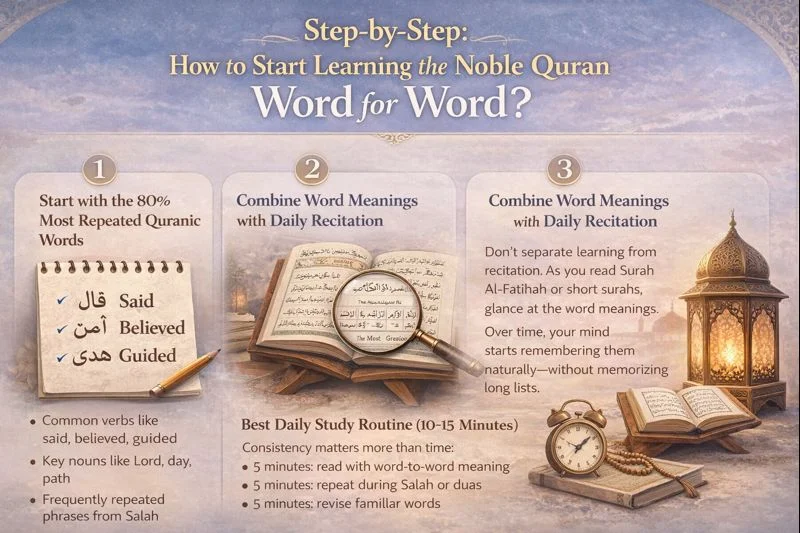
Start with the 80% Most Repeated Quranic Words
Many Quran teachers agree that a small group of words appears again and again in the Quran. Learning these first gives quick results:
- Common verbs like said, believed, guided
- Key nouns like Lord, day, path
- Frequently repeated phrases from Salah
This “small-first” approach builds confidence early.
Combine Word Meanings with Daily Recitation
Don’t separate learning from recitation. As you read Surah Al-Fatihah or short surahs, glance at the word meanings. Over time, your mind starts remembering them naturally—without memorizing long lists.
Best Daily Study Routine (10–15 Minutes)
Consistency matters more than time:
- 5 minutes: read with word-to-word meaning
- 5 minutes: repeat during Salah or duas
- 5 minutes: revise familiar words
Best Quran Word-for-Word Books Available in India
Here are some great Quran word for word resources you can consider if you want to understand the meaning of what you recite—perfect for daily study, Salah, or gifting. Many of these are available on Islamic Book world, Amazon.in, Flipkart, or trusted Islamic bookstores in India.
Features to Look for in a Word-for-Word Quran
- Clear word alignment: Arabic text with meaning right below each word.
- Transliteration option: Helps if you’re still learning Arabic sounds.
- Colour-coded scripts or tajweed markers: Makes reading easier and more engaging.
- Durable binding: For regular use in Salah, study, or travel.
Print vs Digital Copies
Print copies:
- Easy to keep on your desk or prayer area
- Helps build a daily habit
- Ideal for children or families
Digital copies:
- Instant access on phone or tablet
- Searchable and portable
- Great for busy students or professionals
Availability on Amazon.in, Flipkart & Local Islamic Bookstores (Islamic Book world)
- Local Islamic bookstores also stock word-for-word Qurans, and you can feel the paper and script style before buying.
- Special editions like 13 or 15 line Qurans are often available in physical stores.
Buying from an Islamic Books Store Online in India – What to Check
When buying a Quran word for word from an Islamic books store online in India, a few simple checks can save you from disappointment and confusion.
Authenticity of the Noble Quran
Always make sure the Quran text is authentic and error-free. Trusted stores clearly mention the publisher and edition. Avoid unclear or very cheap copies with missing details.
Paper Quality, Script Clarity & Binding
A good Quran should be easy to read and long-lasting:
- Clear Indo-Pak script (13 or 15 lines)
- Thick, non-glare paper
- Strong binding for daily use
This matters even more if children or elders will use it.
Delivery, Returns & Customer Support
Check delivery timelines, return policy, and customer reviews. Platforms like Amazon.in, Flipkart, and known Islamic bookstores usually offer better support.
Is Quran Word-for-Word Enough to Understand the Full Message?
Learning the Quran word for word is a powerful first step—but it’s not meant to replace everything else. It works best as a foundation.
When Word-for-Word Is Perfect
Word-to-word learning is ideal when you want to:
- Understand what you recite in Salah
- Recognize repeated Quranic words
- Build daily connection with the Quran
It turns reading into understanding, especially for beginners and busy learners.
When Tafsir Becomes Important
Some verses need background and explanation. This is where tafsir helps. Tafsir explains context, stories, and deeper lessons that word meanings alone cannot fully cover.
Final Thoughts: Understanding the Quran Is a Journey, Not a Shortcut
Learning the Quran word for word is not about rushing or showing knowledge. It’s about building a real connection with Allah—slowly, honestly, and with intention. Every word you understand adds depth to your Salah and calm to your heart.
You don’t need long hours or complex rules. What matters is consistency:
- Read a little every day
- Understand one new word at a time
- Apply what you learn in prayer
Some days will feel easy. Some won’t. That’s normal.
FAQ Section (People-Also-Ask Style)
1. What is the best Quran word-for-word book in India?
The best Quran word for word book in India is one that uses the Indo-Pak script (13 or 15 lines), clear word alignment, and simple English or Urdu meanings. Look for editions from trusted publishers sold by well-known Islamic bookstores. Quality paper, readable font, and authentic text matter more than brand names.
2. Can I learn Quran word to word without knowing Arabic grammar?
Yes. Quran word to word learning is designed for beginners who don’t know Arabic grammar. It focuses on understanding common words used again and again in the Quran. This helps you understand Salah and daily recitation first. Grammar and tafsir can always be added later, step by step.
3. Is Quran with English transliteration accurate?
A Quran with English transliteration is accurate for pronunciation support, not as a replacement for Arabic text. It helps readers who struggle with Arabic letters pronounce words correctly. For best results, use transliteration along with Arabic text and word-for-word meaning to avoid long-term dependence.
4. Which is better: Quran in Roman Urdu or Urdu translation?
Both serve different purposes. Quran in Roman Urdu helps with reading and pronunciation, while Urdu translation explains the meaning of verses. For learning, many readers prefer a word-for-word Quran that combines Arabic text, Roman Urdu transliteration, and Urdu or English meanings.
5. Are word-for-word Qurans suitable for children?
Yes, word-for-word Qurans are suitable for children, especially for ages 8 and above. They help children connect meaning with recitation early on. Parents often use them as a support tool along with regular Arabic reading, making Quran learning more engaging and less memorization-heavy.
6. Where can I buy an authentic Noble Quran online in India?
You can buy an authentic Noble Quran from trusted Islamic books stores online in India, as well as platforms like Amazon.in and Flipkart. Always check publisher details, reviews, and product images. Well-known Islamic bookstores usually ensure correct text, good print quality, and reliable delivery.
7. How long does it take to understand the Quran word for word?
With regular study, many learners begin understanding common Quranic words within 4–8 weeks. Since many words repeat often, progress feels faster than expected. Spending just 10–15 minutes daily can help you recognize meanings in Salah and short surahs in a short time.